
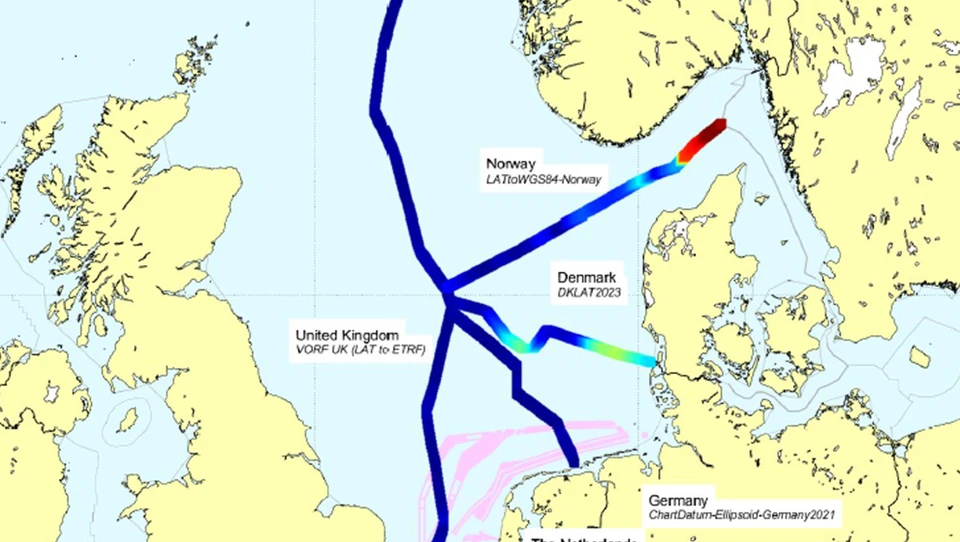
In the North Sea, the chart datum for depths is Lowest Astronomical Tide (LAT). LAT is defined as the lowest conceivable water level that a mariner may encounter, calculated based on the astronomical effects on tides. LAT can be determined in several ways. Traditionally, LAT has been calculated for individual tide gauges or tidal stations, based on long-term observations of water levels.
Modern navigation is largely based on satellite positioning. For this reason, the International Hydrographic Organization (IHO) recommends that nautical charts and hydrographic surveys be based on reference surfaces that are compatible with satellite positioning. This issue has received particular attention within the North Sea regional working group, where other member states have already completed the transition.
The Danish Geodata Agency has therefore decided to realise the LAT chart datum using the Danish Agency for Climate Data’s DKLAT model. DKLAT is a satellite-based model that specifies the position of LAT relative to the ETRS89 ellipsoid (the mathematical representation of the Earth’s shape).
What will change?
Until now, the LAT chart datum has been understood as being derived from various coastal tide gauges. In future, LAT will instead be based on the most recent available DKLAT model, which covers the entire Danish Exclusive Economic Zone (EEZ).
This will enable hydrographic surveying to be carried out directly in chart datum by downloading the model from the Danish Agency for Climate Data and using it onboard survey vessels.
By transitioning to a model that covers the outer Danish waters, it will be possible to achieve higher accuracy in charted depths, as there will be greater confidence in the vertical reference.

Why is the transition taking place?
- More consistent charted depths: DKLAT covers the entire Danish maritime territory and makes it easier to compare depths from different sources.
- Direct use with satellite navigation: With a satellite-compatible reference surface, surveyors can reduce depths directly to LAT without local corrections.
- Reduced administrative burden: By specifying DKLAT as the realisation of the chart datum, collaboration becomes easier for all users of nautical charts and depth data.
- Improved quality and transparency: The DKLAT models are based on satellite altimetry and hydrodynamic data and are continuously updated by the Danish Agency for Climate Data.
- Better preparation for S-100 and future data standards: DKLAT ensures compatibility with 3D and grid-based data structures.
Implications for users
Existing nautical charts will not change immediately, as the differences between the various methods of determining LAT do not necessitate changes to charted soundings.
Hydrographic surveyors are recommended to deliver data in the North Sea referenced to DKLAT (2023) or the most recent version.
Data in other vertical reference systems (e.g. DVR90) can easily be transformed to DKLAT via the ellipsoid.
Tables converting LAT to Mean Sea Level (MSL) and Mean Low Water Springs (MLWS) will be removed from paper charts and the Sailing Directions, as they will no longer be representative.
Effective date and access to the models
The change took effect from September 2025, when the specification of DKLAT as the official realisation of LAT in Danish waters was approved.
The DKLAT models are published by the Danish Agency for Climate Data and can be downloaded together with technical documentation here:
- https://www.klimadatastyrelsen.dk/Media/638507671793973109/007-DKLAT.pdf
- ftp://ftp.sdfe.dk/TransformationsGrids/dklat_2023.tif